The docs your team and their agents both write in
Everyone on your team runs agents now — Claude Code, Cursor, whatever they picked. None of them share anything. Docsmith is one place people and agents both read and write, under the same permissions.
What your team knows is scattered across three places, and none of them is a document
It lives in someone's head
How deploys go. Why you picked that vendor. What actually happened during the outage. Fine until that person is on holiday, or gone.
Or in a thread that's gone by Monday
Written down, technically. Findable by nobody, including the person who wrote it.
And every agent starts from nothing
You explain the same context to Claude Code, then again to Cursor, then again tomorrow. Five people with agents is five separate silos, none of which know what the others learned.
A document, not a blank page
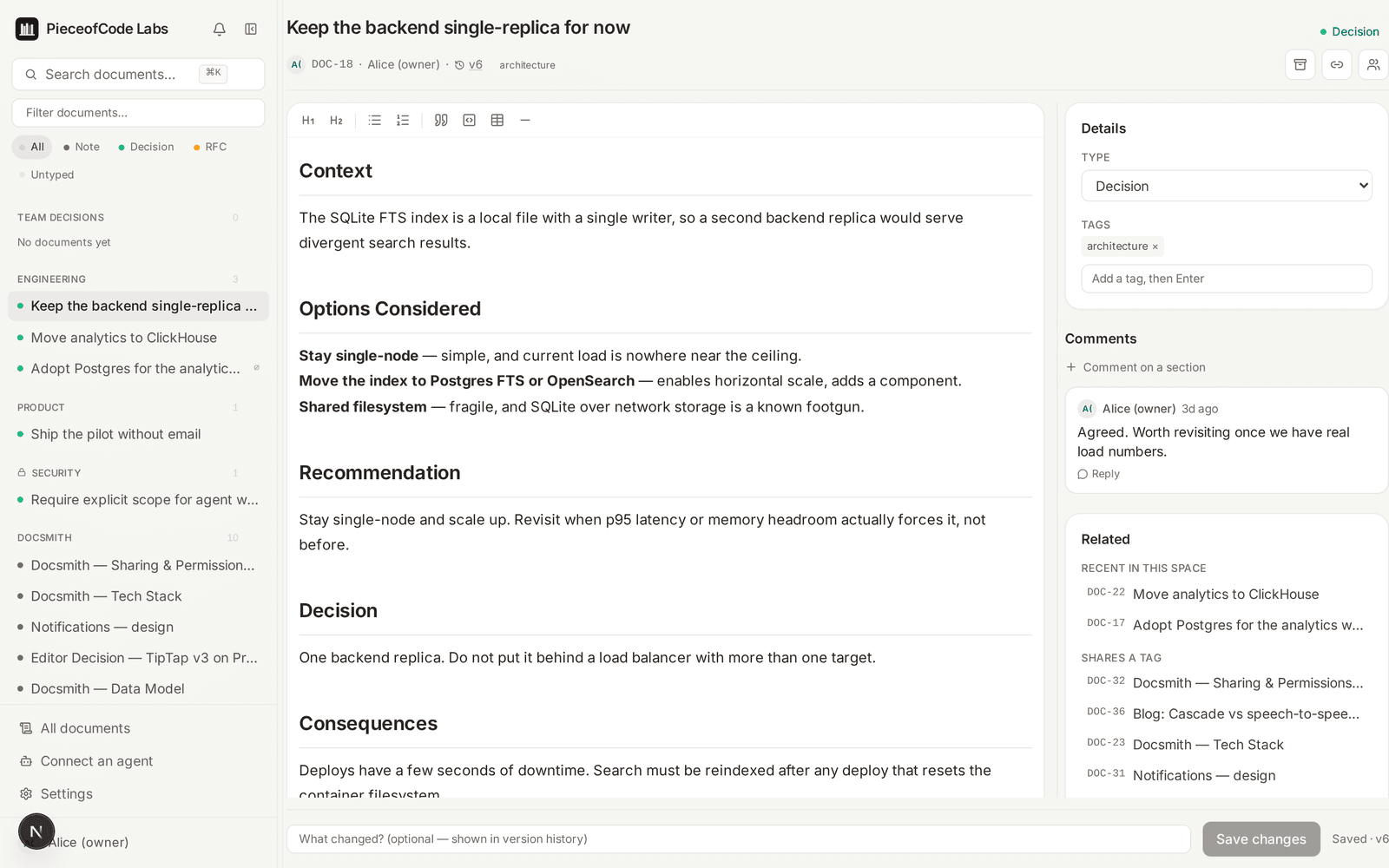
Named sections, comments anchored to the sentence they are about, related work surfaced beside it, and every version kept. This is the whole app — there is no second screen to learn.
What makes this different
One place, two kinds of reader
Connect an agent in about a minute and it can search, read, write and comment — strictly as you, never with more access than your own account has, and only in the spaces you allow. Revoke it and everything holding that key stops at once.
Your workspace
Documents, comments, search
over MCP
Your AI tool
Scoped to your permissions
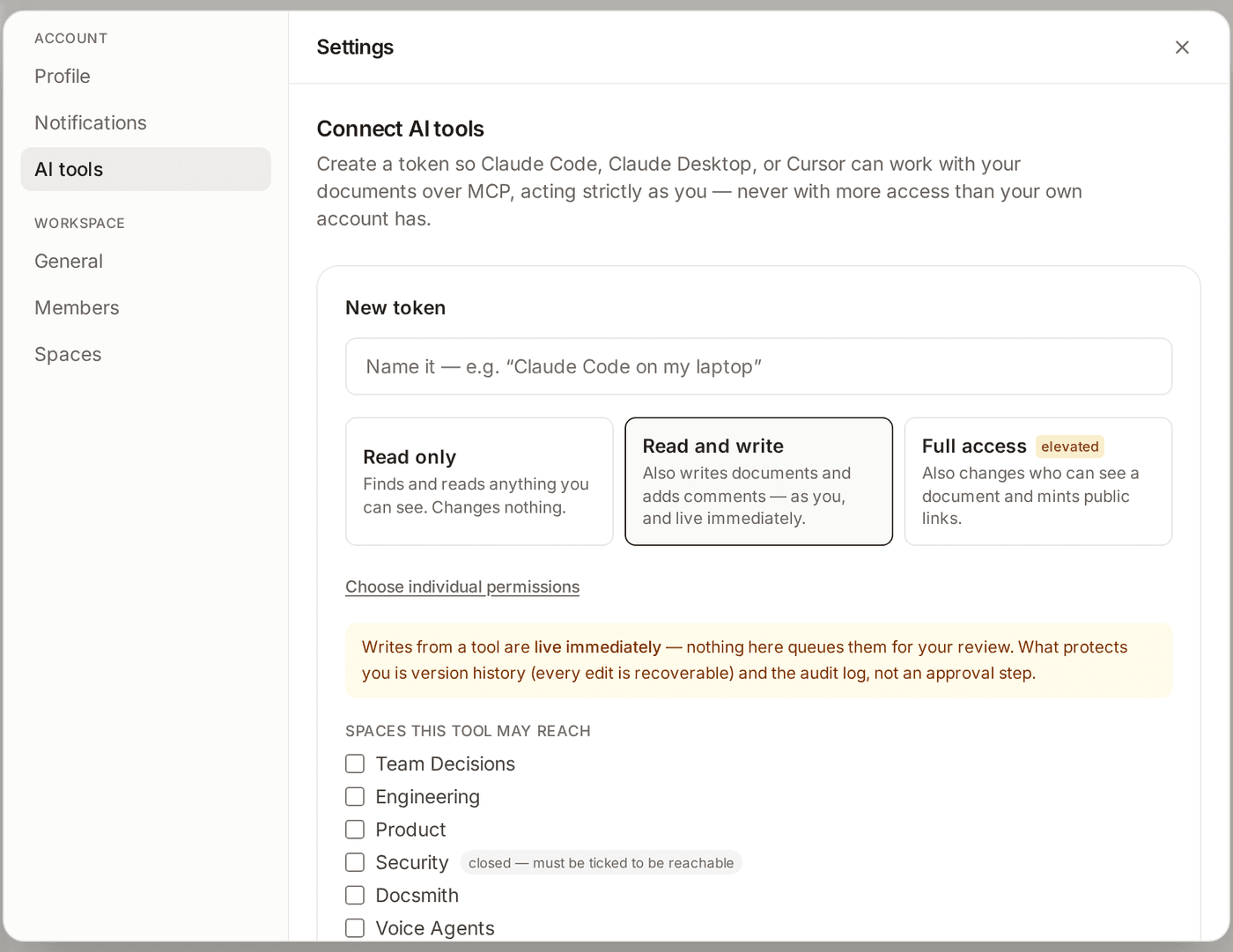
An agent's write is live the moment it lands — there is no approval queue here, for anyone. What protects you is a token that can only narrow your own access, full version history, and an audit log of every call. We would rather say so than let you discover it.
And the part everyone forgets
It tells you when something stopped being true
When a newer document replaces an older one you record it, and the old one says so everywhere it turns up: in search results, in the related panel, and on a public link. The way a shared memory fails is not going missing. It is answering confidently from something that stopped being true — and an agent will do that faster than a person.
Everything else
The ordinary things, done properly
Sections, not a blank page
Pick a type and a document starts with named headings, or don't and write freely. Sections are what make a corpus searchable rather than a pile of prose.
Comments on the sentence
Threads anchor to the exact text they are about, and resolve when they are settled.
Search that reads sections
Full-text across everything the team has written, matched and ranked section by section.
Version history with real diffs
Section-aware: unchanged parts collapse, changed ones break down line by line. Nothing is ever hard-deleted.
Permissions that actually revoke
Container-first. Remove someone from a space and they lose access — including to documents they wrote themselves.
Runs on your own server
Docker Compose on a single box. Documents are markdown files on disk, so you can grep the whole corpus.
The questions people actually ask
- Can an agent overwrite my work?
- Not silently. Edits are compared and swapped section by section, so a person and an agent working on different parts of one document both land. If you genuinely edited the same section, the save is refused and the section is named — never merged behind your back.
- What if an agent writes something wrong?
- Every version is kept and every change is diffable, so you can see exactly what changed and go back. There is no hard delete anywhere in the product, and every agent call is recorded against the token that made it.
- So an agent can just… write to our docs?
- Yes, and it is live the moment it lands — there is no approval queue here, for agents or for people. What protects you is that a token can only ever narrow your own access, plus version history and the audit log. We would rather say that plainly than let you find out.
- Who can see what?
- Spaces are the boundary and documents inherit them, with per-document exceptions where you need them. A document can also be shared as a read-only link for someone with no account at all.
- Can we self-host?
- Yes. Docker Compose on one server, with documents stored as plain markdown plus reverse-delta patches. Nothing about the format needs this product in order to read it later.
- What does it cost?
- Nothing yet — it is in private pilot and is not priced. If you are using it and it is working, we want to hear what it is worth to you before we decide.
Write it down once. Everyone reads it — including the agents.
No Git, no scripts, no training. Open Docsmith, pick “New document,” and start writing.